

Challenges of Next-Generation E/E Architectures Development
The automotive industry is undergoing a profound transformation as vehicles become increasingly connected, software-defined, and data-driven, bringing unprecedented complexity to modern E/E architectures.
Exploding software content, massive data flows, heterogeneous hardware platforms, and the shift toward TSN-based zonal and centralized designs demand strict guarantees on timing, bandwidth, safety, and reliability—while also managing cybersecurity, OTA updates, and rapidly evolving performance requirements.
In this environment, traditional manual design methods and late-stage validation are no longer viable, as they lead to costly redesigns, unsafe configurations, integration delays, and architectures that cannot that cannot support updates and reuse over the platform’s lifetime. Ensuring that resource, timing, and QoS constraints are met before implementation is now essential, making a Correct-by-Design workflow critical for detecting flaws early, preventing unsafe designs, and enabling robust and scalable next-generation vehicle platforms.

One Platform to Tackle the Complexity of Modern Automotive Architectures
Bringing together multi-protocol system modeling, software-network co-simulation, timing-accurate behavioral analysis, mathematical worst-case guarantees, automated configuration, and design-space exploration within a single platform, RTaW-Pegase® enables OEMs and suppliers to systematically address the challenges of next-generation automotive E/E architecture design — including cost and complexity control, safety assurance, scalability, accelerated development, and long-term evolution.
Trusted by the Automotive Industry Worldwide
RTaW-Pegase enables the safety of millions of cars – see the companies that trust us
A Solid Knowledge Base to Accelerate Your Projects
Technical documents, manuals, examples, trainings, R&D papers, and our team’s practical experience constitute a body of knowledge that serves as a solid foundation for your projects.
Experience and Expertise
RTaW Leverages 20 Years of Experience in E/E Architecture Design. Built through numerous vehicle projects worldwide and continuous R&D efforts.
Addressing Key E/E Architecture Challenges With RTaW-Pegase®
Complexity & Diversity of Communication Protocols and Hardware
Pegase supports a wide range of protocols and network types — from TSN-based Ethernet to CAN/FD/XL, LIN, FlexRay, wireless, gateways and more — all within a single platform. This means engineers can model, simulate and analyze mixed architectures without switching tools or approximating behavior.
Strict Timing, Reliability, and Real-Time Constraints
Pegase offers timing-accurate simulation and mathematical worst-case analysis (using Network Calculus) to compute upper bounds on delays, jitters, buffer usage — long before actual hardware or implementation. It also supports QoS, task and TSN scheduling, shaping, preemption, redundancy, policing, and other mechanisms needed to guarantee reliability under all conditions.
Early-phase Design Validation to Prevent Costly Mistakes
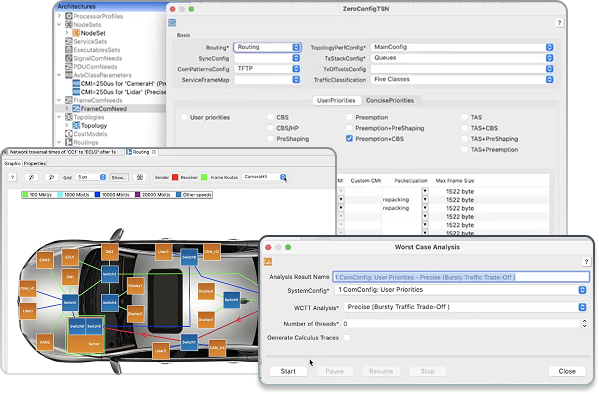
With a “model-based design → automated configuration → simulation/analysis” approach, Pegase enables design-space exploration and early validation of timing, bandwidth, and resource constraints — before implementation. Its built-in tools (e.g., TSN “ZeroConfig-TSN®”, topology optimization, stress testing) allow architects to explore many variants, compare trade-offs (cost, performance, resources), and select optimal designs early following correct-by-design workflow.
Managing Scalability and Future Expansion (Future-Proof Architectures)
Its Design-Space Exploration and Topology Stress Test® modules let you evaluate how many more functions / data flows the current design can support, and identify bottlenecks or resource limits. By optimizing topology, link speeds, switch placement, routing, and resource allocation, Pegase helps avoid over-dimensioning — reducing cost while ensuring headroom for updates and future features.
Reducing Time-to-Market and Engineering Effort
The proprietary ZeroConfig-TSN® algorithm automates TSN configuration (priorities, shaping, scheduling), significantly speeding up network design. Also, because simulation and worst-case analysis are fast (for large networks, in seconds), teams can iterate quickly on different E/E architectures, compare trade-offs, and converge to a robust design — reducing development time, integration delays, and cost.
Integration of Software and Hardware (Software-Defined Vehicles)
The Software-Defined X module of Pegase allows system-level modeling: you can model tasks, their allocation to processors/cores, real-time scheduling, network communication, OS and virtualization layers — and simulate end-to-end behavior (sensor → CPU → network → CPU → actuator). This unified modeling of both software and network layers helps ensure that timing
Automobile modules of RTaW-Pegase®
RTaW-Pegase is modular, allowing you to choose technology-specific modules that tailor the software to the needs of your projects. Discover how each module addresses specific design and validation problems, and supports your team’s workflow:
MODULE DESCRIPTION
- Modelling, Visualization and Variants Management
- Any physical layer including 10BASE-T1S
- Simulation: 802.1Q, CBS, TAS, Preemption, TCP, UDP, TFTP, AFDX, TTEthernet, FRER (CB), SOME/IP (TP), T1S (PLCA), AS-2020, ATS (Qcr), PSFP (Qci)
- Worst-case analysis: 802.1Q, CBS, TAS, Preemption, UDP, AFDX, TTEthernet, FRER (CB), SOME/IP (TP), T1S (PLCA), AS-2020, ATS (Qcr)
- Automated configuration: (redundant) routing, 802.1Q (priorities), CBS (idle slopes), TAS (schedule), T1S (schedule), ATS, Preemption, combining QoS mechanisms
- YANG export: complete network description incl. traffic and configuration parameters, IEEE/IETF compliant models
- What-if analysis: scale load, migration from CAN (FD) to T1S
- Fault-injection: transmission errors, “babbling idiots”
MODULE DESCRIPTION
- Worst-case analysis & timing accurate simulation
- Gateways: CAN – CAN, CAN-Ethernet (Autosar Socket Adapter)
- Automated configuration: Allocation of IDs & offsets
- Traffic model: command & control, audio/video, diagnostics, segmentation, event-triggered, …
- What-if analysis: Migration to CAN FD & CAN 2.0B, scale load
MODULE DESCRIPTION
- Zero-Config TSN® (ZCT): Automated selection and configuration of TSN protocols
- Topology-Stress-Test® (TST): Cost-aware extensibility analysis
- Topology Optimizer® (TOP): Cost and weight-optimization of the communication architecture
MODULE DESCRIPTION
- Simulation & worst-case schedulability analysis
- Service-oriented communications with DDS and SOME/IP (TP)
- Standard RTOS (Autosar Classic) and Hypervisors
- Task scheduling: FPS, NPFPS, schedule tables
- End-to-end delays with Gantt charts: Sensor → CPU → network(s) → CPU → actuator
MODULE DESCRIPTION
- Switched Ethernet and Controller-Area Network
- Trace visualisation as Gantt chart with recognition of protocol messages
- Provide actual performance metrics as seen in the traces (e.g., loads, jitters)
- Identify departures from the specification in the traces (e.g., sizes, transmission patterns, unknown frames)
- Support of industry standard trace formats such as PCAP
MODULE DESCRIPTION
- Simulation & Analysis
- Frame & PDU routing
- Protocol agnostic
- 802.11p support
- Gatewaying to/from wired networks
- Worst-case analysis & simulation
- Gatewaying to/from CAN (FD)
- Autosar support
- Simulation trace visualization
MODULE DESCRIPTION
- Worst-case analysis & simulation of static and dynamic segment
- Gatewaying to/from CAN (FD)
- Simulation trace visualization with Gantt charts
Explore Our Recent Product Updates & Roadmap

News & Events
2026/03:
 RealTime-at-Work will be at the Automotive Ethernet Congress 2026, taking place March 24–26 at the Science Congress Center Munich, Germany. Together with Ethernovia, RTaW will present joint work titled “How to Reign the Rings with TSN” on Day 3 (March 26) at 10:00 a.m. Interested in discussing your TSN challenges? Feel free to reach out to schedule a meeting with us during the event.
 2025/10: A joint work with Renault Group titled ‘Overcoming QoS Challenges in a Full Automotive Ethernet Architecture’ was presented at the IEEE SA Ethernet & IP @ Automotive Technology Day held in Toulouse on October 15-16, 2025. This study explores the use of 10Base-T1S with optimized PLCA configuration in a zonal-oriented architecture to meet strong real-time requirements in a next-generation, fully Ethernet-based E/E architecture. Download presentation slides.
2025/05: RTaW is thrilled to become a NXP Partner and provide its expertise and toolset to the NXP CoreRide platform.
2024/10: A joint work with BMW titled ‘Automotive System Requirements on Traffic Shaping’ was presented at the TSN/A Conference in Stuttgart on October 1-2, 2024. This study compares CBS and ATS traffic shapers, focusing on latency and memory utilization in a BMW pre-series vehicle. Download presentation slides.
2024/03: At the Automotive Ethernet Congress in Munich (March 5-7, 2024), we presented ‘How DDS and TSN Can Help Manage a Flexible In-Vehicle Network Architecture: Paving the Way to Software-Defined Networking.’ This presentation was part of a collaborative effort with our technology partner, Real-Time Innovations. Download presentation slides. Watch recorded webinar with RTI.
2024/04: RTaW showcased Pegase at Embedded World 2024 (Nuremberg, April 9-11) and Automotive Software Strategies 2024 (Munich, April 24-25). Additionally, RTaW CTO, Jörn Migge, participated in a round table on TSN during the industry day of the WFCS 2024 conference (Toulouse, April 17-19).
2023/09: RTaW and RTI Partner to Deliver DDS & TSN Solutions for Automotive Systems.
